

Identity area
Reference code
Title
Date(s)
- 1905-1990 (Creation)
Level of description
Extent and medium
25.13 linear feet (21 document cases, 2 card file boxes, 7 oversize boxes, 5 record boxes) Audio-visual materials, Sound recordings, Photographs, Scrapbooks
Context area
Name of creator
Biographical history
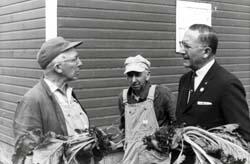
Ben Reifel (1906–1990) was the first Lakota Sioux elected to the U.S. Congress. He was born September 19, 1906, in a log cabin on the Rosebud Reservation in South Dakota, the son of a German American father and a full-blooded Lakota Sioux mother. An enrolled member of the Rosebud Sioux Tribe, he was given the Lakota name Lone Feather. Reifel grew up bilingual and attended both a reservation boarding school and a local county school, completing the eighth grade at age sixteen. After working on his parents’ farm, he studied at the School of Agriculture in Brookings, South Dakota, and later enrolled at South Dakota State College, graduating in 1932 with a degree in agriculture. He financed his education through one of the first federal loans available to Native American students and was elected president of the Students’ Association in his senior year. In 1933, he married Alice Janet Johnson, and they had one daughter, Loyce Nadine.
Reifel began his career with the Bureau of Indian Affairs (BIA) in 1933 as a farm agent on the Pine Ridge Reservation and was soon promoted to field agent, where he helped implement the Indian Reorganization Act of 1934. His work advancing agricultural programs and economic development earned him recognition across South Dakota reservations. During World War II, he served in the U.S. Army, rising to Lieutenant Colonel and distinguishing himself in the European theater. Following the war, he returned to the BIA, serving as Tribal Relations Officer and later as Superintendent of the Fort Berthold Reservation in North Dakota. In 1949, he entered Harvard University, earning a master’s degree in 1950 and a doctorate in public administration in 1952. He then returned to the BIA as Area Director of the Aberdeen Area Office, overseeing federal Indian programs in South Dakota, North Dakota, and Nebraska.
In 1960, Reifel resigned from the BIA to run for Congress. He was elected as a Republican to represent South Dakota’s First District and served five terms. In Congress, he focused on agriculture, Native American education, and civil rights. He advocated desegregation in Indian schools, was instrumental in bringing the Earth Resources Observation Systems (EROS) center to South Dakota, and supported the creation of the National Endowment for the Humanities. As a member of the House Agriculture Committee and later the Appropriations Committee, he defended farm subsidies and advanced irrigation projects critical to the regional economy. He chose not to seek re-election in 1970.
After leaving Congress, Reifel continued public service as chairman of the National Capital Planning Commission, Special Assistant for Indian Programs to the Director of the National Park Service, and Interim Commissioner of Indian Affairs under President Gerald Ford. He was active in civic organizations, particularly the Boy Scouts of America, receiving the Silver Antelope, Silver Beaver, Silver Buffalo, and Gray Wolf awards. He also served on the National Council of the Protestant Episcopal Church and as trustee and board president of the South Dakota Art Museum, where he established its first Native American collection.
Reifel received numerous honors, including the Department of the Interior’s Distinguished Service Award and honorary doctorates from South Dakota State University, the University of South Dakota, and Northern State College. After the death of his first wife, Alice, in 1972, he married Frances U. Colby. He continued his advocacy for Native American rights and education until his death from cancer on January 2, 1990. His legacy endures in his contributions to Native American policy, public service, and South Dakota’s cultural and political life.
Archival history
Immediate source of acquisition or transfer
Content and structure area
Scope and content
The Ben Reifel Papers document the career of Ben Reifel, the first Lakota Sioux to serve in the U.S. Congress, highlighting his work as a legislator, his tenure with the Bureau of Indian Affairs, and his advocacy for Native American communities. The collection includes correspondence, photographs, audiovisual materials, memorabilia, and scrapbooks that provide insight into his contributions to public service and Native American affairs. As a pioneering Native American leader, Reifel played a key role in shaping policies related to education, healthcare, and economic development. This collection serves as a valuable resource for understanding his lasting impact on indigenous representation in government and South Dakota's political landscape.
The activities series contains records of Reifel's involvement with various organizations and initiatives, including the Boy Scouts of America, the National Park Service, and the Dakota Territory Citizen Certificates project. It also covers his efforts in Native American affairs, congressional trips, and public events. The awards and honors section features certificates, plaques, medals, and other recognitions Reifel received throughout his career, including awards from the Boy Scouts of America, Sioux tribes, and South Dakota State University.
The Bureau of Indian Affairs materials include correspondence, newsletters, and newspaper clippings that document Reifel's work in advancing Native American education, healthcare, and policy. The campaign series provides an in-depth look at his political career through financial records, advertisements, schedules, and materials related to the South Dakota Republican Party platforms.
Correspondence within the collection spans from Reifel's tenure with the BIA through his congressional career, featuring letters exchanged with prominent political figures such as Barry Goldwater, Lyndon B. Johnson, Richard Nixon, and George McGovern. The family history section contains biographical materials, educational records, military service documents, and personal writings that provide insight into his early life and career development.
Memorabilia in the collection includes campaign materials, presidential inauguration items, and personal artifacts such as a U.S. Annotated Code book with Reifel's name embossed on the cover. The photographs offer a visual record of his political career, community interactions, travels, and personal life, particularly highlighting his work in Congress and his connections with Native American communities.
The audiovisual materials consist of campaign advertisements, legislative discussions, interviews, and speeches on healthcare, agriculture, and public service. These recordings also include public appearances and fundraising events. Scrapbooks primarily contain newspaper clippings and campaign materials that document Reifel's public image and key political milestones.
Collected materials include books, periodicals, programs, and poetry reflecting Reifel's diverse interests and professional pursuits. His speeches and writings consist of transcripts and drafts of addresses given at events such as Memorial Day ceremonies and commencement exercises.
Overall, the Ben Reifel Papersprovides a comprehensive view of his contributions to public service, Native American advocacy, and South Dakota’s civic and political landscape. It serves as a valuable resource for researchers seeking to understand his legislative impact, community engagement, and personal legacy.
Appraisal, destruction and scheduling
Accruals
System of arrangement
Conditions of access and use area
Conditions governing access
Information request form: Ask Us!
- This collection is open for research in the Reading Room; materials cannot be checked out.
- Not all materials are digitized due to copyright, donor restrictions, or physical condition.
- Contact us in advance to prepare for your visit. If you cannot visit, we will do our best to help remotely.
Telephone: 605-688-5094
Email: arcrefs@sdstate.edu
Conditions governing reproduction
Reproduction of materials from the collection is subject to the following conditions:
- Permission: Written permission must be obtained from the SDSU Archives for any reproduction, publication, or quotation of materials.
- Copyright: Users are responsible for complying with copyright laws and securing any necessary permissions from copyright holders.
- Fragile Materials: Some items may not be reproduced due to their fragile condition.
- Charges: Reproduction charges may apply, and users will be informed of any costs in advance.
- Acknowledgment: Any reproduced material must include proper acknowledgment of the South Dakota State University Archives and Special Collections as the source.
For more information or to request permission, please contact the SDSU Archives.
Language of material
English
Script of material
Language and script notes
Physical characteristics and technical requirements
Using this inventory
- This inventory lists the collection’s materials; not all are digitized due to copyright, restrictions, or condition.
- If available, digital links appear in the folder details. Select a folder title and scroll down to view the record details.
Finding aids
Uploaded finding aid
Allied materials area
Existence and location of originals
Existence and location of copies
Related units of description
Notes area
Note
Copyright and Use Statement
In Copyright This Item is protected by copyright and/or related rights. You are free to use this Item in any way that is permitted by the copyright and related rights legislation that applies to your use. For other uses, you need to obtain permission from the rights-holder(s).
Materials in this collection may be subject to Title 17, Section 108 of the United States Copyright Act. Users are responsible for ensuring compliance with copyright, privacy, trademark, and other applicable rights for their intended use. Obtaining all necessary permissions is the user's responsibility. Written authorization from the copyright and/or other rights holders is required for publication, distribution, or any use of protected materials beyond what is permitted under fair use.
Alternative identifier(s)
Access points
Subject access points
Name access points
- Reifel, Ben, 1906-1990 (Subject)
- United States. Bureau of Indian Affairs (Subject)
- United States. Congress. House (Subject)